
Understanding Tax Filer Status
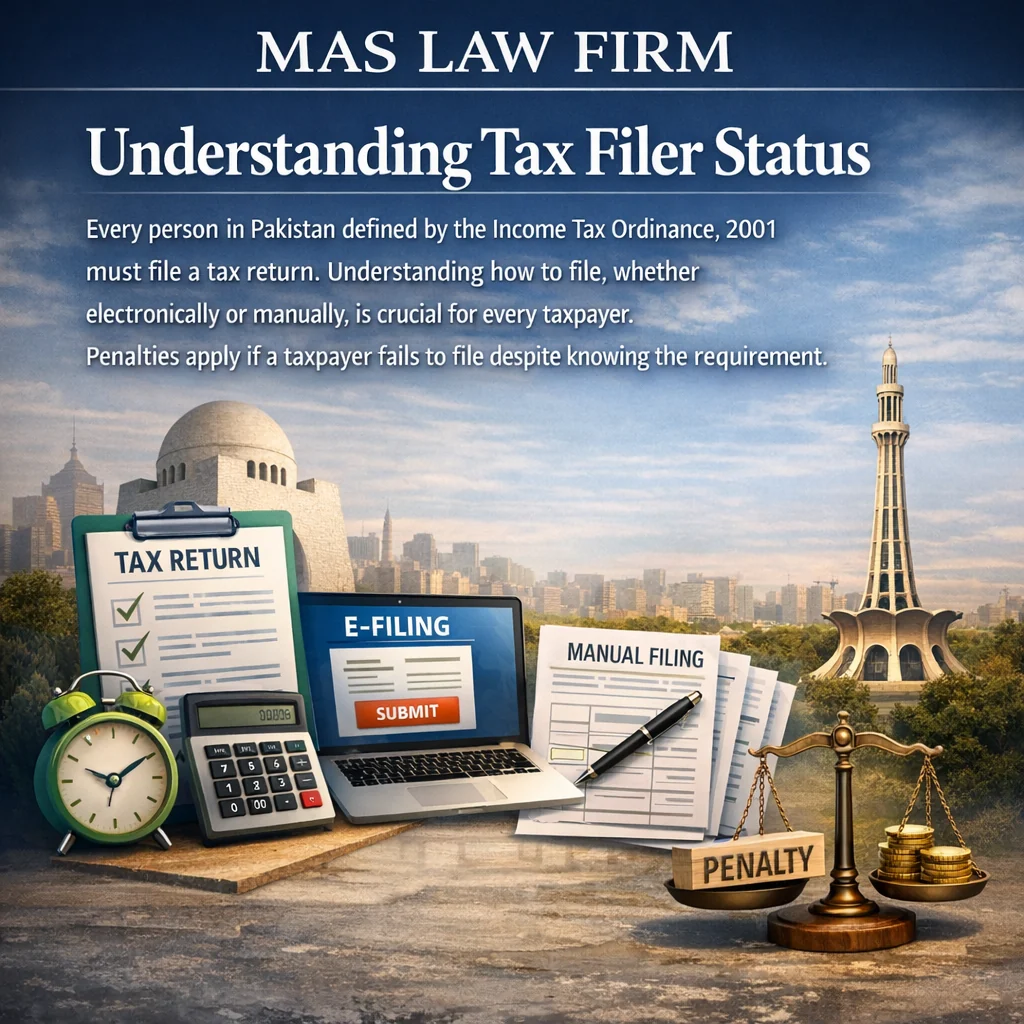
Every person in Pakistan defined by the Income Tax Ordinance, 2001 must file a tax return. Understanding how to file, whether electronically or manually, is crucial for every taxpayer. Penalties apply if a taxpayer fails to file despite knowing the requirement.
Filer vs Non-Filer
The Government of Pakistan classifies taxpayers as filers and non-filers:
- Filer: Submits their Income Tax Return with all FBR requirements
- Non-Filer: Does not file income tax return
Tax filers enjoy benefits in transactions like property deals, cash withdrawals, bank profits, and dividends.
Two Methods for Filing Income Tax Return
Manual Filing of Income Tax Return
- Download the Income Tax Form from FBR Website
- Complete Personal Particulars, Source of Income, Business/Personal Expenses, Taxes, and Deductions for Income Tax Return. Include Assets, Liabilities, and Reconciliation for Wealth Statement for the relevant Tax Year.
- After completing the forms, sign and submit them to the relevant department. Remember to keep the acknowledgment.
Online Filing / E-File of Income Tax Return
- Taxpayers must have a valid NTN for filing income tax returns
- Register with FBR to create an account on IRIS
- After registering with FBR, access the system to file your Income Tax Return
- Log into the FBR System, complete the required information, and submit your Income Tax Return and Wealth Statement
Checklist for Filing Tax Return
This is the tax checklist for collecting documents and forms needed to file an Income Tax Return and become a filer in Pakistan.
Personal Information
FBR IRIS Login is mandatory. All taxpayers need:
- Login USER ID
- Password
Documents for Salaried Individual
- CNIC copy
- Salary certificate
- Bank statement
- Tax deduction certificate
- Proof of investment (if any)
- Utility bills
Additional Documents for Salaried Individuals
- Tax Deduction Certificate of Financial Year (July to June)
- Record of tax payments made for cash withdrawals, banking instruments, children's school fees, mobile and telephone bills, motor vehicle registration and tokens, and property transactions
- Any additional income source: rent, bank profits, dividends, prize bonds, foreign income, capital gains, gifts, inheritance (if any)
Documents for Business Individuals and Self-Employed
- Verification of amounts through income records (e.g., Business Bank Statements and Accounts)
- Records of all expenses: cheque registers, credit card statements, salary, rent, utilities, travel, communication, etc.
- Information on business-use assets (cost, service start date, etc.) for depreciation
- Office in home information, if applicable
- Record of tax payments made via cash withdrawals, banking instruments, electricity, school fees, mobile and telephone bills, vehicle registration and tokens, property transactions, etc.
- Any extra income: rent, bank profits, dividends, prize bonds, foreign income, capital gains, gifts, inheritance if applicable
Documents for Rental Income
- Records of income and expenses
- Information on rental assets (cost, service start date, etc.) for depreciation
- Tax Payment Record for Financial Year July to June
- Additional sources of income: bank profits, dividends, prize bonds, foreign income, capital gains, pension, gifts, inheritance, if applicable
Documents for Retirement Income
- Pension/annuity income/Retirement Benefits
- Social security income (if any)
- Record of Tax Payments made during the Financial Year
- Additional sources of income: rent, bank profits, dividends, prize bonds, foreign income, capital gains, gifts, inheritance (if any)
Documents for Savings & Investments or Dividends
- Interest, dividend income
- Income from stocks or other property
- Dates of acquisition, records of purchase cost, or other basis in sold property
- Expenses related to your investments
- Record of tax payments made for cash withdrawals, banking instruments, children's school fees, mobile and telephone bills, motor vehicle registration and tokens, property transactions, capital gains on securities, gifts, and inheritance
Wealth Statement - Personal Assets and Liabilities
| Assets | Liabilities |
|---|---|
| Agricultural Property | Credit (Non-Business): Advance / Borrowing / Credit / Deposit / Loan / Mortgage / Overdraft / Payable |
| Commercial, Industrial, Residential Property (Non-Business) | |
| Business Capital | |
| Equipment (Non-Business) | |
| Animal (Non-Business) | |
| Investment (Non-Business): Account / Annuity / Bond / Certificate / Debenture / Deposit / Fund / Instrument / Policy / Share / Stock / Unit, etc. | |
| Debt (Non-Business): Advance / Debt / Deposit / Prepayment / Receivable / Security | |
| Motor Vehicle (Non-Business) | |
| Precious Possession | |
| Household Effect | |
| Personal Item | |
| Cash (Non-Business) | |
| Any Other Asset: Gold Jewelry, Prize Bonds etc | |
| Assets in Others' Name: Spouse, Children, Parents, Brother | |
| Assets held outside Pakistan |
Active Taxpayer List in Pakistan
When the Income Tax Return and Wealth Statement are submitted, the taxpayer becomes a filer once the FBR system updates its records each Sunday night. Check your Active Taxpayer status by visiting the FBR website or sending a message to 9966 with "ATL CNIC" (ATL 35202 XXXXXXX1).
Benefits of Becoming a Tax Filer
Filing an Income Tax Return is mandatory. Individuals, firms, and companies with Active Taxpayer status receive benefits from various sectors in Pakistan.
Tax Benefits
- Less Taxes in Buying/Selling/Transfer of Immovable Property
- Less Taxes on Registration/Transfer/Token of Motor Vehicles
- Less Taxes on WHT on Cash Withdrawal from Banks
- No taxes on issuing banking instruments (cheques, pay orders, demand drafts) and money transfers
- Reduced taxes on bank profits, savings certificates, dividends, commissions, prize bond winnings, etc.
- Less Taxes on providing professional Services
Other Benefits
- Preference for eligibility in all bank loan applications
- Eligibility for government tenders and corporate panel registration
- Simple Income Evaluation for Visa Applications
- Avoidance from Audit and Penalty of Rs. 40,000/- for non-filing of Income Tax Return
Tax Refunds and Adjustments
In Pakistan, tax filers can claim refunds or adjustments for the following when filing their income tax returns:
- Withdrawal of cash from the bank per section 231
- Advance Tax on sale or transfer of immovable property under Section 236C
- Advance Tax on events and gatherings under Section 236D
- Advance Tax Collection by Educational Institutions under Section 236I
- Advance Tax on purchasing immovable property under Section 236K
- Income Tax/Withholding Tax on motor vehicle purchase, registration, transfer, and token under section 234
- Advance Tax on Domestic Electricity Use under Section 235A
- Advance Tax on International Air Tickets under Section 236L
- Advance Tax on non-cash Banking Transactions under section 236P
- Withholding tax on mobile phone bills per section 236(1)(a)
- Withholding Tax on Telephone Landline Bills under section 236
- Advance Tax on Purchase of Air Ticket under section 236B
Important Note
If the taxpayer files their Income Tax Return and Wealth Statement for the first time, they won't become a filer until the filing deadline passes. To gain immediate Active Taxpayer status in Pakistan, they must also submit the previous year's Income Tax Return and Wealth Statement with a surcharge of Rs. 1000.
Need Help Becoming a Tax Filer?
MAS Law Firm provides expert guidance on tax return filing. Contact us for assistance.